

Introduction
The Korean goat industry is at a turning point owing to the rapid expansion of production scale and consumer demand for goat meat, with its production value increasing nearly three-fold, from 59.5 billion Korean Won (KRW) in 2018 to 187.7 billion KRW in 2023 (Statistics Korea, 2023). This trend is mirrored in slaughter statistics, which increased from 284,121 head in 2015 to 572,305 head in 2019, and remained relatively high at 423,430 head in 2023 (MAFRA, 2024). Traditionally, goat meat in Korea has been consumed as a medicinal food, typically in the form of hot water extracts with herbal ingredients (Choi et al., 2022). Following the COVID-19 pandemic, its consumption as a health-promoting supplement has further increased, reflecting growing public interest in immune system-enhancing products. In Korea, goat meat has recently gained attention as a low-fat, high-protein meat resource, leading to the increased demand for fresh lean cuts (Kim et al., 2019a).
In the meat industry, traceability systems, carcass quality grading standards, and standardized cutting and fabrication criteria collectively constitute a fundamental framework for ensuring safe distribution, fair trade, transparency, industrial efficiency, and consumer confidence in meat products (Kongsro et al., 2026). In Korea, livestock product management is primarily regulated through national systems that oversee slaughter inspection, hygiene control, and distribution traceability, including mandatory animal identification, slaughterhouse inspection, and product labeling requirements. While these systems effectively ensure food safety and traceability, they are mainly designed around carcass grading and sanitary management, with limited emphasis on standardized cutting and fabrication criteria for minor livestock species such as goats. After slaughter, livestock carcasses are partitioned according to the established cutting and fabrication methods based on their anatomical and physiological characteristics, including muscle structure and location and distribution of fat and connective tissue, that directly influence the eating quality attributes of meat (Listrat et al., 2016). Furthermore, the muscle fiber profile and connective tissue density are closely related to meat tenderness and processing characteristics, making them key factors in determining the appropriate cutting and fabrication criteria. Therefore, establishing standardized cutting and fabrication criteria must reflect these intrinsic quality differences, which can maximize the economic and informational value of each cut, while facilitating systematic distribution and rational pricing throughout the market.
From a consumer perspective, standardized cutting and fabrication criteria affect purchase decisions and shape the perception of meat quality (Glitsch, 2000). Specific and consistent names and classification of cuts directly influence market demand by improving product transparency and consumer perception clarity. Moreover, standardization systems considering each country’s culinary culture and cooking style enhance product acceptance and promote trust in the domestic and international markets (Tibebu et al., 2024).
In Korea, however, standardized cutting and fabrication criteria, which serve as fundamental guidelines for the efficient distribution and utilization of fresh goat meat, are currently lacking, limiting industrial growth. Therefore, establishing standardized cutting and fabrication systems specifically tailored to both intrinsic and extrinsic characteristics will enhance product consistency, consumer trust, and industrial competitiveness. This review proposes a conceptual framework that integrates anatomical, technological, consumer, and industrial perspectives to guide practical and applicable standardized cutting and fabrication criteria for Korean goat meat.
Overview of Korean Native Black Goats
Korean native black goats (Capra hircus coreanae) are indigenous breeds that have been maintained for centuries to adapt to the Korean living environment. Their external appearance is characterized by black hair, curved horns, and small body size, with an average mature weight of 30–50 kg, lower than that of Boer goats and other commercial meat breeds (Kim et al., 2019a). Four distinct regional lineages of black goats, Dangjin, Jangsu, Gyeongsang National University, and Tongyeong, have been identified, each reflecting adaptation to specific local ecological and feeding conditions (Kang et al., 2023). Although relatively small in body size, Korean native black goats exhibit strong disease resistance, efficient feed utilization, and high survival in mountainous and low-input farming systems, making them valuable genetic resources for sustainable production (Park et al., 2025).
Genetic analyses have shown the development of genetic introgression in exotic breeds, such as Boer and Saanen (Kim et al., 2019a). Partial introgression is also detectable in certain farm-raised populations, reflecting ongoing efforts to enhance growth performance and production efficiency under practical farming conditions. Moreover, Korean native black goats have cultural and economic significance. Traditionally consumed as a medicinal food for its high protein and mineral content, recently goat meat is increasingly valued as a low-fat, high-protein source suitable for fresh meat production (Choi et al., 2023; Kim et al., 2022). To encourage consumer preference for healthier and more sustainable meat products, it is essential to establish standardized cutting and fabrication criteria that reflect the anatomical characteristics and practical applications of this indigenous breed, thereby facilitating its broader adoption in modern meat markets. Recent statistics also show a clear rise in demand for black goat meat in Korea, with the domestic black goat population increasing by more than 70% from 2012 to 2021 and imports growing substantially in recent years, reflecting consumers’ heightened interest in healthier and more sustainable protein sources (Statistics Korea, 2023). Although the differences among regional lineages are relatively small, variations in body size, growth rate, and muscle development may lead to subtle changes in carcass yield and intramuscular fat distribution. These characteristics suggest that such lineage-based differences should be considered when establishing more refined and evidence-based cutting standards in the future.
Anatomical Characteristics of Korean Native Black Goats
Korean native black goats are ruminants, and their overall skeletal structure follows the anatomical arrangement observed in cattle. The axial skeleton, composed of the spine, ribs, scapula, and limb bones, is similar to that of other ruminant species (Lee et al., 2025; Singh, 2017). However, the proportional development of individual body parts and the overall carcass size are more comparable to those of pigs than to cattle, which is an important consideration when designing slaughtering, cutting, and fabrication systems, making the direct adoption of beef or pork cutting standards not applicable (Son, 1999). By contrast, beef tenderloins typically weigh approximately 2.7–3.2 kg (primarily steers, aged 18–24 months), pork tenderloins weigh approximately 1.2 kg (primarily barrows, aged 22–26 weeks), and goat tenderloins typically weigh approximately 0.71 kg (primarily steers, aged 5–6 months; Chao et al., 2024; Segura et al., 2023; Wang et al., 2025). Therefore, systematic anatomical assessment is required to clarify the morphological characteristics of Korean native black goats for the development of species-specific cutting and fabrication criteria.
Korean native black goats possess 13 pairs of ribs, similar to most goat and pig species, which serve as crucial reference points for delineating the forequarter, middle body (including the ribs, loin, and belly), and hindquarter regions of the carcass (Constantinescu, 2001). Owing to their relatively small carcass size and lower weight compared with cattle, segmented division and simplified fabrication units are preferable, particularly when defining the loin and abdominal sections. The forelimb region exhibits a distinct muscular configuration around the scapula, providing a clear anatomical reference for establishing cutting lines. In the loin and abdominal regions, the junction between the lumbar vertebrae and iliac bones marks the primary boundary for carcass division, whereas in the hind limb, well-developed femoral and gluteal muscle groups necessitate finer segmentation for practical processing (Ali et al., 2021). These anatomical distinctions underscore why cattle-based fabrication schemes are not directly applicable to Korean native black goats. In particular, the junction between the lumbar vertebrae and the ilium in Korean native black goats is shorter than that of cattle and narrower and less robust than that of pigs, which may increase the risk of excessive muscle loss when applying cattle-based cutting lines. Furthermore, the fascial structure around the scapular region is relatively complex compared with cattle, making it difficult to obtain anatomically clear boundaries when existing bovine cutting schemes are directly applied.
In summary, although Korean native black goats share a ruminant skeletal framework with cattle, their overall body size (approximately 50–60 kg live weight) is far smaller than that of beef cattle (typically >600 kg live weight) and is closer to that of commercial pigs (approximately 100–120 kg live weight), resulting in regional muscle development patterns that resemble pigs rather than large-bodied cattle (Uyen et al., 2023). Therefore, the development of species-specific cutting and fabrication standards for Korean native black goats should appropriately balance the anatomical characteristics common to both cattle and pigs (Brassard et al., 2024).
Current Practices and Challenges in Carcass Cutting of Korean Native Black Goats
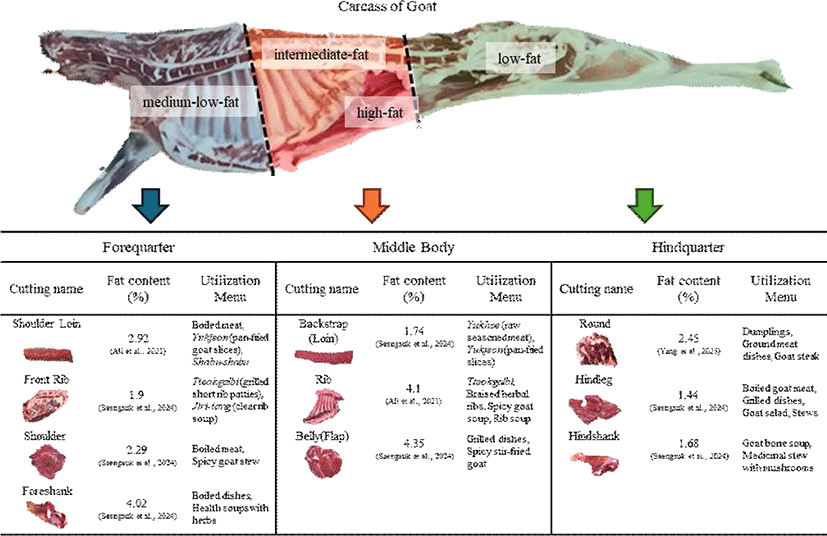
Despite increased demand for goat meat, a standardized carcass cutting and fabrication system is lacking, revealing the industrial limitations of the domestic retail sector (Anneke et al., 2025; Moon et al., 2021). Goat carcasses in Korea are typically separated into three primary sections—the forequarter, middle body (ribs, loin, and belly), and the hindquarter— followed by partial deboning before distribution to restaurants, health food stores, and general households (Anneke et al., 2025). As illustrated in Fig. 1, which depicts the proposed carcass sectioning scheme, the forequarter is generally separated at the 5th to 6th attached ribs; the middle body section comprises the loin, ribs, and belly; and the hindquarter is obtained by disarticulating the femur joint and removing the lower shank. This simplified cutting approach considers the small carcass size of black goats but presents several structural limitations (Saengsuk et al., 2024). From a consumer perspective, the lack of standardized retail cuts restricts selection diversity and creates confusion among producers, distributors, and consumers due to inconsistent names and cutting shapes (Choi, 2023), hindering accurate price estimation and quality comparison, consequently limiting the consumption of traditional dishes such as bulgogi (Korean soy sauce-marinated meat), hot pots, and soups (Park et al., 2020).
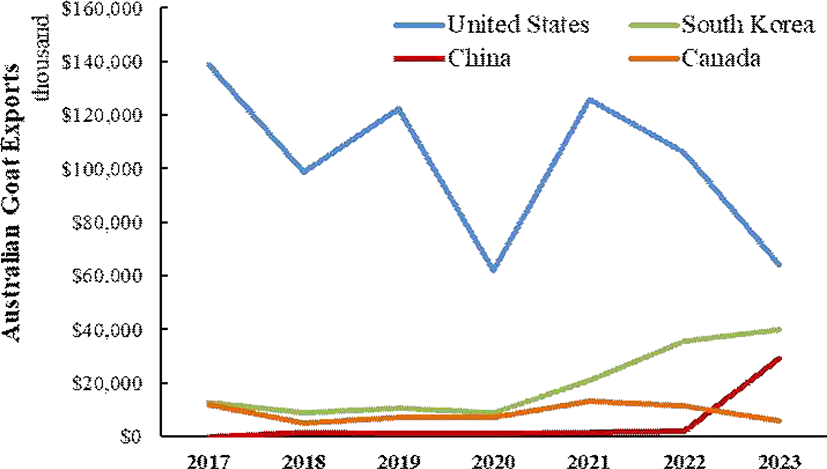
Major goat-producing countries such as Australia and New Zealand have standardized carcass division and fabrication systems comparable to those used for beef and lamb. Although Australia’s AUS-MEAT system defines standardized primal cuts for large, export-oriented goat carcasses, direct application to Korean black goats is limited by their smaller carcass size and domestic market orientation. Nevertheless, because Korean black goats share a ruminant skeletal framework with cattle, the AUS-MEAT primal structure (Table 1) can serve as an anatomical reference, while practical implementation in Korea requires simplified, locally adapted cutting strategies. Moreover, alternate fabrication formats—including whole carcasses and six-way cuts—have been implemented according to the specifications of key trading partners including the United States, Korea, China, and Canada (Fig. 2). Furthermore, fat-trimming levels and packaging requirements are customized according to market demand, providing flexibility, thus strengthening export competitiveness. Since 2018, imports of goat meat from Australia and New Zealand have consistently increased, with Australian products accounting for approximately 98.8% of the total imports to Korea, largely due to tariff reductions following the Korea–Australia and Korea–New Zealand Free Trade Agreements (Lee, 2025).
Current Utilization of Korean Native Black Goats in the Food Service Sector
In Korea, native black goats have long been recognized as a traditional health food valued for their nutritional properties, including high levels of protein, amino acids, and iron, which are associated with various health-promoting effects (Kim et al., 2019b). In the past, native black goat consumption in Korea showed distinct regional characteristics (Son, 1999). Based on an online survey conducted by the authors (including restaurant menus, franchise websites, and regional food-related online sources), clear regional differences were identified in consumption patterns and preferred cuts of Korean native black goat meat.
In Jeolla Province, Korean native black goat meat has traditionally been utilized across a wide range of cuts, including ribs, loins, legs, and offal, reflecting a cuisine-oriented approach that emphasizes grilling, pan-frying, and seasoned dishes. The development of restaurant franchises originating from this region has contributed to the nationwide dissemination and commercialization of these preparation styles, positioning Jeolla cuisine as a key driver in the modernization of black goat meat consumption.
Although Chungcheong Province hosts a large number of black goat farms, its utilization patterns remain relatively limited in terms of region-specific dishes. Goat meat produced in this region is primarily processed and distributed to other provinces, reinforcing its role as a raw material supply base rather than a center of culinary innovation.
In Gyeongsang Province, farm-based restaurants commonly employ a diversified utilization strategy, applying different cuts to boiling, grilling, raw meat dishes, and processed products. The active use of secondary cuts and by-products in this region reflects a practical, whole-carcass utilization approach that enhances menu diversity and economic efficiency.
Gangwon Province, characterized by mountainous terrain suitable for goat farming, emphasizes health-oriented preparations, including soups, stews, and grilled dishes often combined with local medicinal ingredients. This regional pattern highlights the close association between black goat meat consumption and wellness-focused culinary traditions.
In the capital region, where regional food cultures converge, Korean native black goat meat is utilized in both traditional health-focused dishes and modern fusion menus. This trend reflects urban consumer preferences for convenience, variety, and novel culinary applications, supported by advanced distribution and food service infrastructures.
Taken together, these regional utilization patterns demonstrate that, while culinary expressions differ, the fundamental use of carcass components remains broadly similar across regions. The gradual convergence toward standardized menus and centralized processing underscores the growing importance of unified cutting and fabrication criteria to support consistent quality, pricing, and product development in the expanding goat meat market.
Recommendation on Cutting Method for Korean Native Black Goat
Based on the anatomical characteristics and relatively small carcass size of Korean native black goats, a half-carcass division incorporating a three-primal cutting and ten-subprimal fabrication system is recommended to improve the processing efficiency and market utilization (Fig. 1). The boundaries between primal and sub-primal cuts were defined using reproducible anatomical landmarks, including rib count, vertebral transitions, major joint structures, and natural fascial planes, to ensure consistent fabrication while minimizing muscle loss and improving applicability compared with cattle-based cutting schemes. According to the compositional data presented in Fig. 1, the forequarter exhibits a fat content ranging from approximately 1.9% to 4.02%, which can be categorized as medium-to-low-fat. Within this section, most muscles have between 1.9% and 2.9% fat content, whereas the foreshank contains relatively more connective tissue and a slightly elevated fat level (4.02%), contributing to the upper limit of the range. The middle body contains 1.74%–4.10% fat content, with most muscles displaying intermediate fat levels, whereas the belly (flap) represents a localized high-fat area with approximately 4.35% fat. In contrast, the hindquarter shows a distinctly low-fat profile of 1.44% to 2.45% (Saengsuk et al., 2024). These classifications were used to describe the relative fat distribution and guide the recommended culinary applications for each primal region.
Forequarter: This section includes the shoulder, neck, and anterior ribs (up to the 5th–6th rib). Muscles in this region contain a moderate amount of connective tissue and medium-to-low fat, making them suitable for boiling, stewing, or slicing.
Middle body: This section extends from the posterior ribs to the lumbar vertebrae, and contains the ribeye, loin, and belly muscles. It is characterized by intermediate to high fat content and good tenderness, making it ideal for grilling.
Hindquarter: This section includes the leg and hip regions, primarily composed of the femoral and gluteal muscle groups. These muscles are low in fat and slightly tougher but flavorful, making them suitable for slicing, marinating, or processing into value-added products such as sausages or ready-to-cook meat.
Each primal section can be further divided into smaller sub-primal cuts according to muscle structure, cooking method, and market preference. For example, the hind legs can be separated into the semimembranosus, semitendinosus, and biceps femoris muscles to produce various product types. Establishing this standardized cutting framework will increase carcass yield and price transparency, and facilitate the development of diverse goat meat products that reflect consumer preferences and culinary styles.
Research Perspectives on the Future Development of the Korean Goat Industry
To ensure further growth and competitiveness, future research should adopt a multidisciplinary approach that connects animal science, food technology, and policy innovation. In Korea, where black goats are mainly raised for medicinal purposes, recent research has begun to focus more on meat-oriented breeding and industrial applications, especially in areas such as carcass standardization, quality grading, and value-added product development (Abhijith et al., 2023).
From a technological viewpoint, future studies should aim to establish data-driven cutting and fabrication systems supported by anatomical, biochemical, and imaging analyses. Computed tomography (CT) and 3D carcass modeling can provide precise structural information. Combining these approaches with molecular and proteomic techniques will deepen our understanding of factors that influence meat tenderness, flavor, and functional properties, thereby supporting scientifically validated differentiation among proposed cuts (Anderson et al., 2015). In addition, sustainable production systems such as smart farming technologies and resource-efficient management remain important, but their relevance lies primarily in providing uniform animals and production conditions, which in turn enhances the reliability of standardized cutting and grading systems (Teixeira et al., 2020).
Taken together, research that effectively links scientific innovation, industrial practices, and institutional standardization will aid the advancement of the Korean goat industry. These multidisciplinary approaches will enable the coordinated evolution of production, processing, and marketing systems, while enhancing export potential through compatibility with international carcass and cut classification frameworks such as AUS-MEAT and IMPS, thereby supporting global competitiveness and sustainability in the meat industry.
Conclusion
The Korean native black goat industry is transforming from its traditional medicinal role to a modern meat production system. However, commercially raised goats in Korea show substantial genetic heterogeneity due to extensive crossbreeding, leading to marked variability in carcass traits and highlighting the need to establish fixed and reproducible carcass characteristics as a prerequisite for effective standardization and industrial development. Also, the lack of standardized cutting and fabrication criteria limit industrial development. This review highlights that species-specific anatomical characteristic necessitate three-primal cutting and ten-subprimal fabrication concepts comprising the forequarter (shoulder loin, front rib, shoulder, and foreshank), middle body (loin, rib, and belly), and the hindquarter (round, hind leg, and hindshank) to ensure efficient processing, fair trade, and transparent product classification. Establishing such a standardized system would enhance consumer confidence, improve carcass utilization, and strengthen the overall industry competitiveness. Future advancements will rely on the integration of scientific innovation with institutional support, particularly in the development of carcass grading, labeling, and pricing systems suited for improved goat strains. Moving toward a unified and evidence-based standard will increase domestic self-sufficiency and position Korean goat meat as a globally recognized, high-quality, and sustainable protein source.


